Spec-Driven Development (SDD) Is the Future of Software Engineering
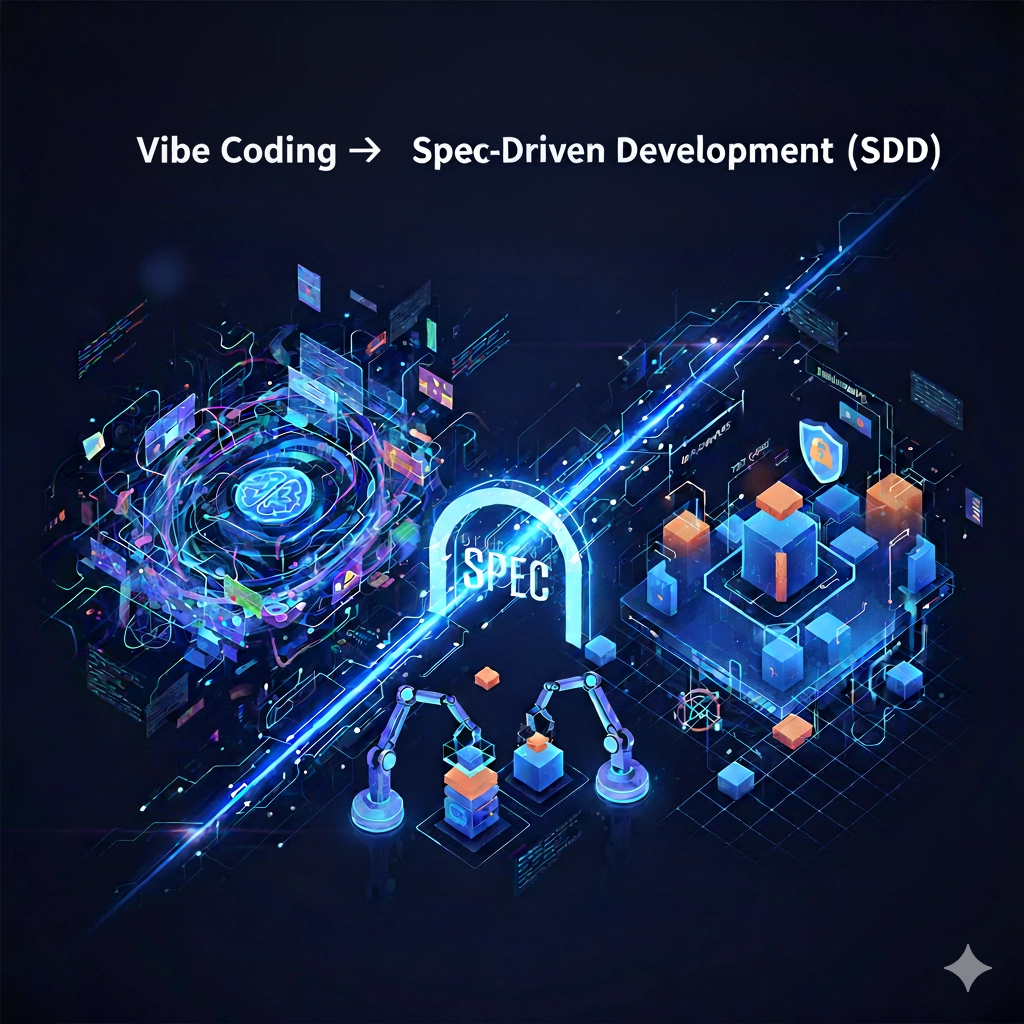
1. The Trap of "Vibe Coding"
The initial "magic" of AI tools like Cursor, where a few prompts can build a prototype in hours. However, as projects scale, this approach fails because:
-
Inconsistency: AI begins creating duplicate functions, inconsistent styling, and conflicting state management.
-
Technical Debt: Without a plan, the AI "hallucinates" patterns or breaks existing logic, leading to expensive and time-consuming fixes.
-
The "Ceiling": AI can’t solve problems you don't conceptually understand; it only amplifies your existing architectural knowledge (or lack thereof).
2. What is Spec-Driven Development (SDD)?
SDD isn't actually a new invention; it's the application of "Software Engineering 101" (requirements, design, and architecture) specifically tailored for AI agents.
Instead of asking the AI to "build a feature," you provide:
-
A Clear Spec: A detailed document explaining the problem, user flow, technical requirements, and acceptance criteria.
-
Contextual Guardrails: A "living document" or "employee handbook" for the AI that defines your project's state management, folder structure, API patterns, and styling rules.
-
The AI as a Junior Dev: You treat the AI as a highly skilled but inexperienced teammate who needs clear instructions to stay on track.
3. Why it Works
By shifting the focus from "writing code" to "writing specs," I've found:
-
Massive Speed Gains: A task that took 4 hours of "back-and-forth" prompting with vibe coding was completed in 30 minutes with a proper spec.
-
Better Integration: Code generated with context matches the existing codebase, reducing bugs and refactoring time.
-
Sustainable Scaling: The developer acts as the Architect, focusing on system design and user experience while the AI handles the syntax and implementation.
4. The Future Profile of an Engineer
My conclusion is the most successful "AI-era" developers won't necessarily be the best syntax experts, but those with:
-
System Thinking: Understanding how the frontend, backend, and data flow together.
-
Product Sense: Knowing what to build and how it should feel for the user.
-
Code Literacy: The ability to read, evaluate, and critique AI code rather than just writing it from scratch.
The Bottom Line: The future of software engineering isn't about typing faster; it’s about thinking more clearly. Spec-Driven Development is the bridge that allows developers to move from "prompting and hoping" to systematic, professional engineering.